





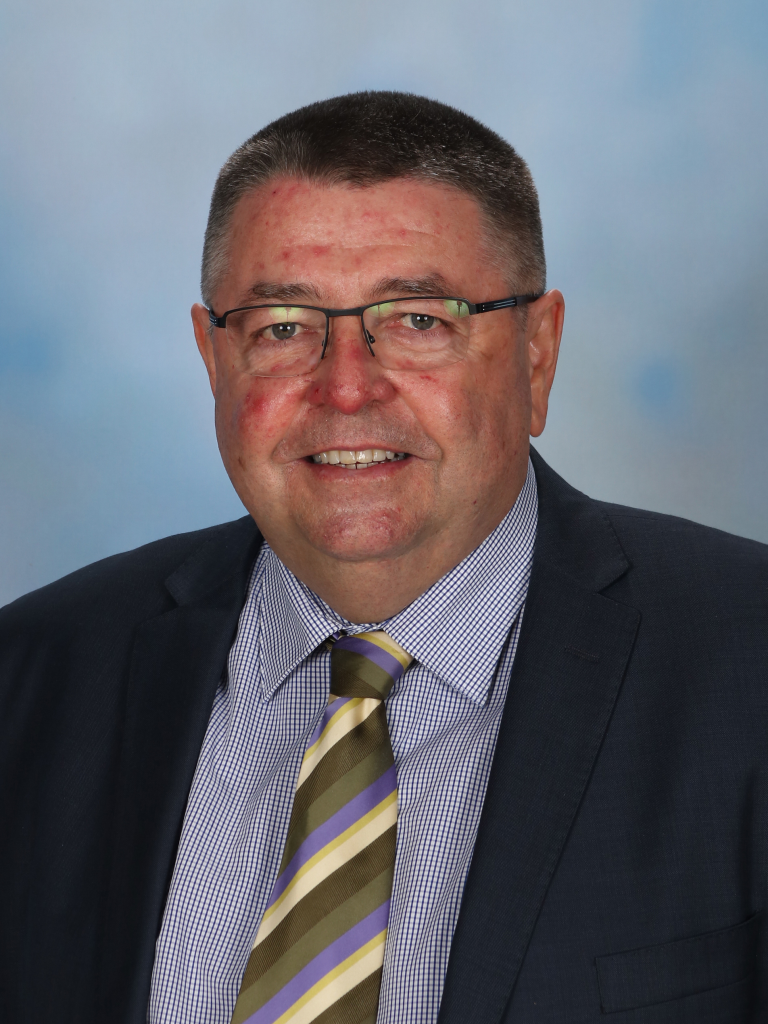
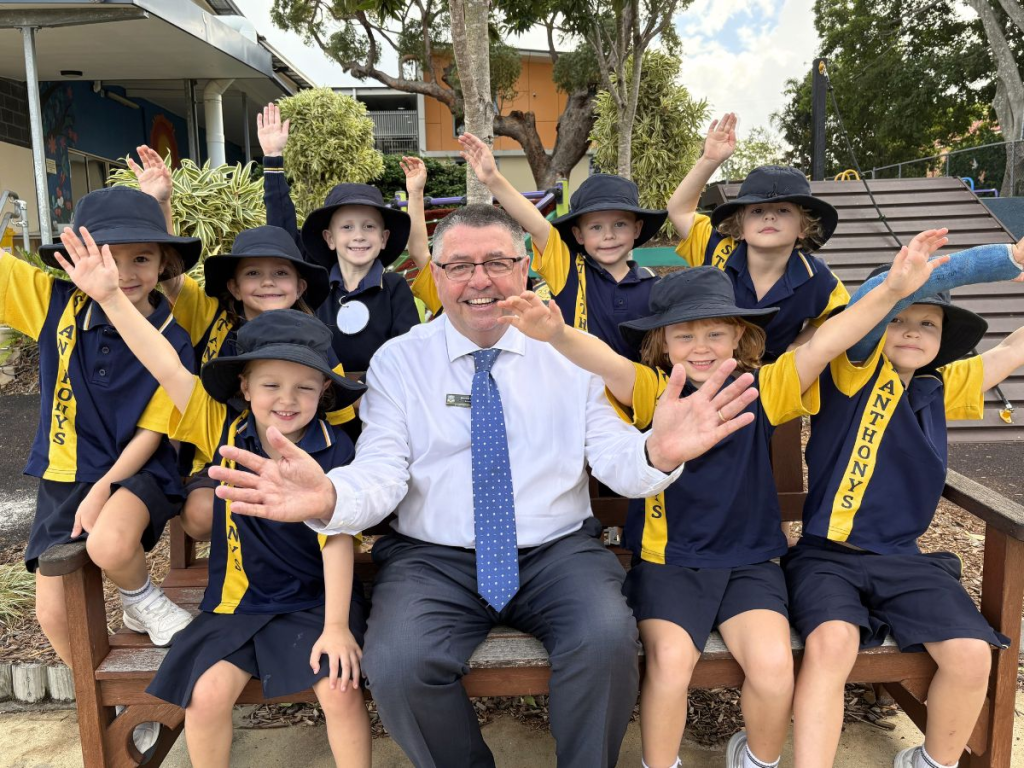
Martin Wilkie retired from St Anthony’s School in Kedron in Week 2 of Term 2, closing a 44-year career with Brisbane Catholic Education that began in a classroom not unlike the one he sat in as a child, and ended at the helm of one of BCE’s largest primary schools, with almost 700 students and five streams of Prep and Year One.
The scale of the farewell was something he did not entirely see coming. Once he announced his retirement, former students, parents and staff came to him in a steady stream to say what his leadership had meant to them.
“I have truly been humbled by this experience,” Wilkie said.
It is a fitting end for a principal who spent three decades making a point of being visible, present and genuinely invested in the people around him.
From a Dairy Farm to a Classroom
Long before he arrived in Kedron, Wilkie’s journey began on a dairy farm in the Scenic Rim. Life as a schoolboy involved a daily quarter-mile trek to the farm gate before catching a 30-minute bus into Beaudesert, where he attended St Mary’s School from 1966 to 1972.
The bus did not drop Catholic students at their school gate, so there was an extra walk at the end too. None of it deterred him.
His mother had been a teacher before marrying a dairy farmer, and her influence, combined with a clear-eyed sense that farming life was not for him, pointed him toward the classroom. Wilkie eventually traded the farm for the blackboard, returning to his old stomping grounds at St Mary’s to kick off his teaching career. He spent his first six years there before moving through the Brisbane Catholic Education system.
The world he retired from looks almost nothing like the one he entered. In the 1960s, classes of 40 students in a single stream were the norm. Wilkie grew up in an era of single stream classes with 40 students, and now he retires from a busy metropolitan school. At St Anthony’s, he led nearly 700 students, including five streams of Prep and Year One alone.
Thirty Years in the Principal’s Chair
Wilkie’s first principal appointment was at St Elizabeth’s School in Tarragindi, where he also became engaged, married and a father to twin boys in the span of two years. He describes the community’s celebration of every milestone with warmth that has clearly not faded.
An early lesson in the weight of the role came in 1995, when he was appointed Acting Principal at St Elizabeth’s following the sudden death of the principal from a heart attack at his desk. That moment shaped how Wilkie understood the relationship between work and life for the rest of his career.
“I learnt very quickly that there had to be a life outside of work as much as possible,” he said.
He and his wife, also a teacher, raised three children through his years as a principal. He acknowledges missing every one of their first days at school because of his professional responsibilities, but credits a philosophy of putting family first, for his staff as much as for himself, with building the kind of culture that sustained his schools.
“Happy staff equals happy school,” he said. “It doesn’t matter how much social media marketing a school may have, if you have a happy staff, happy families. The school will market itself.”
What He Built at Kedron
Wilkie spent nine years leading St Anthony’s, and his hopes for its future reflect what he worked to build during that time. Wilkie’s nine-year tenure at Kedron was defined by the school’s unique Franciscan identity. He worked closely with the neighbouring Mount Alvernia and Padua Colleges, ensuring St Anthony’s remained a vital part of the local Franciscan Parish.
“We have something incredibly unique here at Kedron with the Franciscan Friars and Missionary Franciscan Sisters still a visible presence in the community,” he said.
His practical advice for the principals who will follow him centres on something he considers non-negotiable: get out of the office. He was in the playground at almost every break and around the school before and after hours throughout his 30 years as a principal, and he argues that visibility is not optional.
“My advice to aspiring principals is not to forget that we are there for the students,” he said. “Sitting in the office in back-to-back meetings or dealing with administrative tasks could always wait.”
For the students he is leaving behind, his parting message is quieter and more personal: be kind, be compassionate, and appreciate the education in front of you.
A New Chapter After 44 Years
Wilkie closes his BCE career knowing the next cyclone, severe thunderstorm or pandemic, the kinds of events that kept him awake through countless nights in the principal role, will no longer demand his presence at school on a Sunday afternoon. He is ready for that.
“Finally, after 30 years, I can just look after my own family,” he said.
For enrolment enquiries or more information about St Anthony’s School Kedron, visit the school’s website at sta.bne.catholic.edu.au or phone the school directly.
Published 30-April-2026


